

Since 1898
Since 1898
*using high quality
domestic and imported parts

Is an Adult Three-Wheeler Harder to Ride Than a Bike?
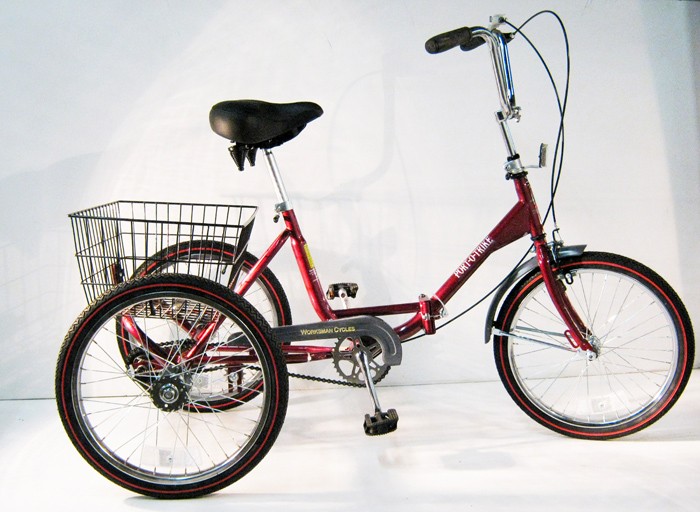 Yes, an adult three-wheeler is usually harder to ride than a standard bicycle. At Worksman Cycles, we think it’s better to say that plainly than to dance around it.
A bicycle is more efficient. It carries less weight, leans naturally through turns, and usually rolls with less resistance. A three-wheeler is built around a different priority. Many models use heavier-duty frames and components than a typical bicycle. That design changes how the ride feels, and it explains why pedaling often takes more effort.
Why an Adult Three-Wheeler Usually Takes More Effort
The first reason is simple mass and mechanical drag. An adult trike usually has more frame material, an extra wheel, a wider rear section, and more parts turning underneath you. Even before you get into rider technique, that means there is more machine to move.
Worksman’s adult three-wheeler line includes compact folding models, larger recreational trikes, and industrial style machines, many with sturdy construction and multi-wheel setups that clearly are not trying to mimic the stripped-down efficiency of a road or hybrid bicycle. That added structure supports balance and durability, but you feel it when starting from a stop and when trying to build speed.
The second reason is rolling resistance. Three tires on the ground generally create more friction than two. That doesn’t mean every ride feels dramatically harder, but it does mean the machine tends to ask for more steady input from your legs. On a bicycle, once you get moving, momentum often builds quickly, and the bike keeps that smooth, easy flow. On a trike, the ride can feel a bit more planted and a bit less eager. That isn’t a flaw; it’s the trade-off that comes with a platform designed to stay upright on its own rather than relying on lean and balance.
What the Rider Actually Feels on the Road
When people ask whether a three-wheeler is harder to ride, they’re often not asking about technical efficiency. They want to know what their body will notice. Usually, the answer shows up in three places: startup effort, cruising feel and turning feel.
The startup effort is where many riders first notice the difference. Getting an adult three-wheeler moving from a dead stop often takes a little more push than getting a standard bike rolling. That is especially true if the three-wheeler is built with a sturdy frame or heavier components. Once you’re moving, the trike can feel steady and predictable, but the first few pedal strokes often tell the story right away. A bicycle tends to respond faster. A trike tends to respond more deliberately.
Cruising and Turning
Cruising feel is different, too. A bicycle often feels lively. It glides, leans and carries speed with less effort. An adult three-wheeler, on the other hand, usually feels more anchored. Some riders find that reassuring, while others find it slower or heavier.
Both reactions make sense. The machine is doing something different underneath you. It’s giving up some efficiency to offer a ride that is less dependent on balance. If you expect it to feel like a two-wheeled bike, it may seem stubborn. If you expect it to feel stable and composed, the ride makes more sense.
Turning is where people sometimes misunderstand the phrase “harder to ride.” A bicycle leans into turns. That lean is part of what makes riding feel smooth and natural. An adult three-wheeler doesn’t corner the same way. The rider has to steer through the turn rather than lean through it in the same flowing way. It’s not necessarily harder in the sense of being unmanageable. It is harder because the feedback is different. You feel more of the machine’s width and more of the steering input. The ride asks for adjustment rather than automatic bike habits.
Harder Doesn’t Mean Worse
This is the point that often gets lost. Saying a three-wheeler requires more effort is not the same as saying it’s a bad choice. It only means the rider should understand what kind of effort is involved. In many cases, the extra effort is the direct result of the feature the rider wanted in the first place: a cycle that prioritizes stability and control over speed and efficiency. These cycles are built around steadiness, durable construction, and a ride character distinct from that of a lightweight bicycle.
That’s why the comparison has to stay honest. If your only standard is how easily a machine converts pedaling into forward motion, the bicycle wins. It’s lighter, simpler and more efficient. If your standard includes staying upright at stops, feeling planted while riding, or preferring a machine that doesn’t depend on the same balance dynamic as a bicycle, then the extra effort may not be the deciding issue at all. In that case, “harder to ride” is really just shorthand for “less efficient, but more stable.”
Should That Difference Change Your Decision?
For most buyers, the answer is no, not by itself. The extra effort should be understood, but it shouldn’t be exaggerated. The real question is whether you’re choosing based on efficiency or based on ride character. If you want the easiest pedaling and the most bicycle-like handling, a standard bike will usually feel better. If you want a machine designed for steadiness and control, an adult three-wheeler may still be the better fit, even though it asks more of your legs.
We also think it helps to separate effort from difficulty. A three-wheeler often takes more energy, but that doesn’t automatically make it harder in every way. Some riders find the lack of balancing stress makes the overall experience feel more comfortable, even though the machine itself is less efficient. Others notice the opposite and prefer the quicker response of a bicycle. Neither reaction is wrong. What matters is understanding that the added effort comes from the design, not from a defect or a poor riding technique.
For most riders, that difference isn’t a dealbreaker whatsoever. It’s simply the cost of getting the ride character a three-wheeler is meant to provide.