

Since 1898
Since 1898
*using high quality
domestic and imported parts

How Adult Three Wheelers Help Seniors Keep Moving Safely
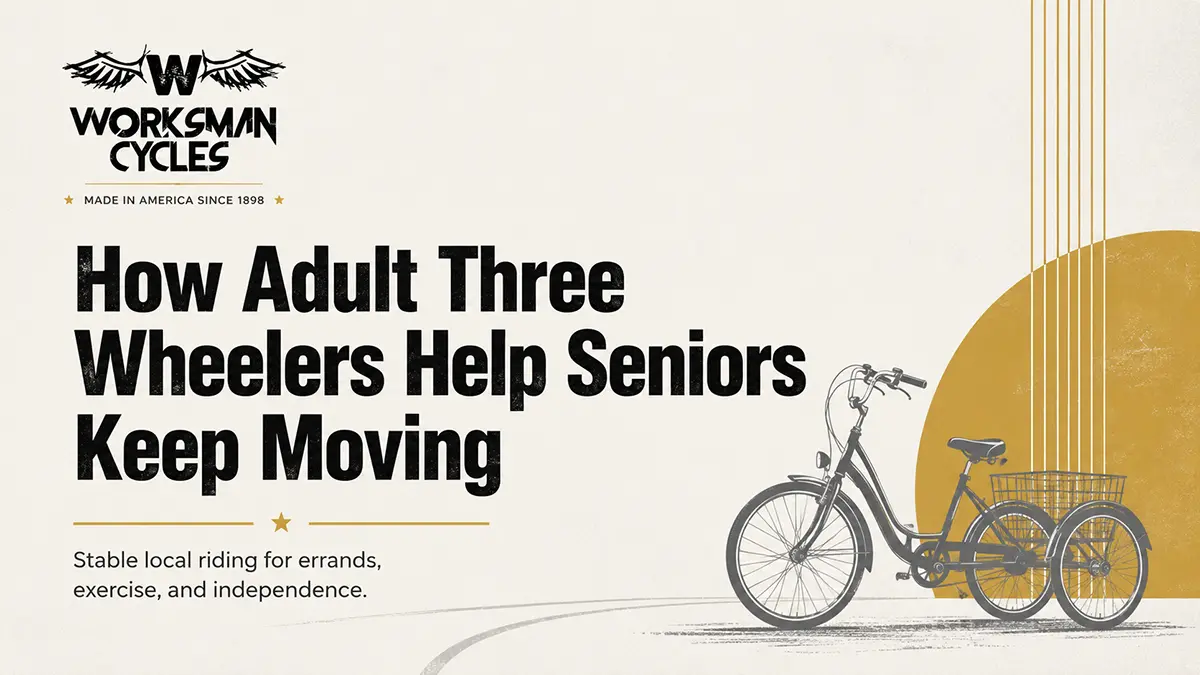
An adult three wheeler gives seniors a practical way to keep riding when a traditional bicycle starts to feel unstable, tiring, or hard to control. The real advantage is not only recreation. It is the ability to stay active, carry groceries, visit nearby places, ride with family, and keep local independence without depending on a car for every short trip.
This matters more as the country ages. The U.S. Census Bureau reported in 2025 that the U.S. population age 65 and older reached 61.2 million in 2024, up 3.1% from the previous year. More older adults means more families will need realistic mobility options that fit daily life, not only medical devices, cars, or walking routes that no longer feel manageable.
For Worksman Cycles, the better conversation is not whether seniors need a tricycle. The better conversation is about how the right adult three-wheeler helps older riders adapt without giving up the movement, errands, routines, and outdoor time that support independence.
Why Adult Three Wheelers Solve a Different Problem than Traditional Bikes
Many seniors do not stop riding because they dislike cycling. They stop because the hardest parts of cycling become less forgiving. Starting from a stop, stepping onto the bike, turning slowly, carrying bags, and putting a foot down at the right time all require balance and confidence.
A traditional bicycle depends on continuous balance. That works well for riders who feel comfortable on two wheels. But for seniors who feel less steady than they used to, the bike itself becomes part of the hesitation. Even a short ride can feel stressful if the rider worries about stopping, wobbling, or tipping while moving slowly.
An adult three wheeler changes that experience. The three-wheel layout gives the rider a wider base of support. It helps the bike feel steadier when the rider slows down, starts again, or pauses during a neighborhood ride. That does not make every ride risk-free. Riders still need safe routes, careful turning, proper fit, and realistic speed. However, the design directly addresses one of the main reasons older adults lose confidence on a standard bicycle.
The Three-Wheel Advantage Is About Confidence, Not Speed
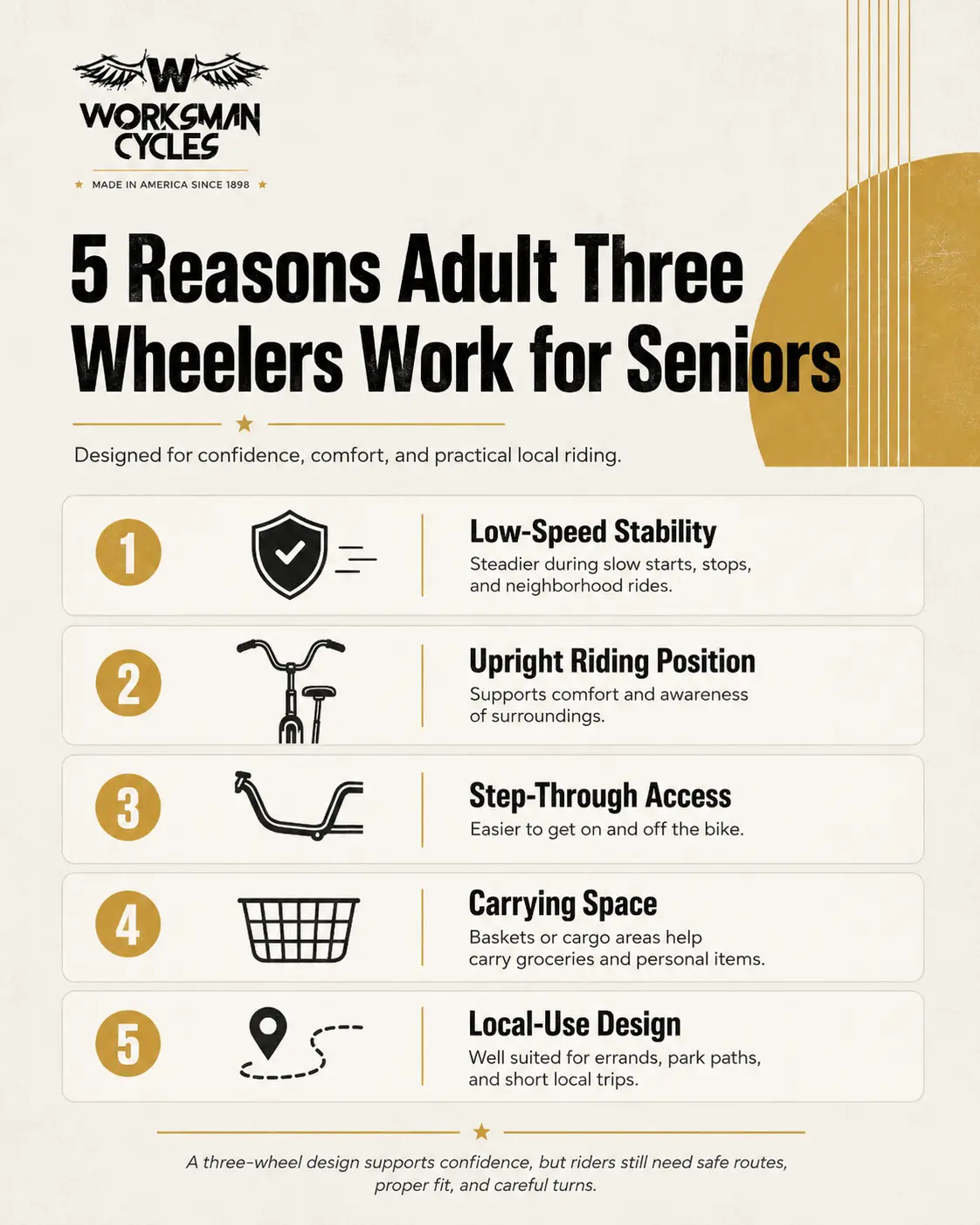
Adult three wheelers are not built to replace performance bikes. They are built for stable, useful, repeatable movement. That distinction matters. Seniors are usually not looking for aggressive speed, sharp cornering, or sport cycling geometry. They need a bike that helps them feel in control during ordinary use.
Several design features support that goal:
- Low-speed stability:Three wheels help the bike feel steadier during slow starts, stops, and short neighborhood trips.
- Upright riding position: A more upright posture helps many riders feel more comfortable and aware of their surroundings.
- Step-through access:Many adult three wheeler designs reduce the difficulty of getting on and off the bike.
- Useful carrying space:Rear baskets or cargo areas help riders carry groceries, bags, gardening supplies, or personal items without hanging weight from the handlebars.
- Steady local-use design:Adult three wheelers are best suited for practical riding, such as errands, park paths, neighborhood routes, and short local trips.
These features matter because senior mobility often breaks down in small moments. The rider may still have the strength to pedal, but no longer feel confident balancing a two-wheel bike at a stop sign, carrying a bag, or restarting on a quiet street. A good adult three wheeler helps reduce those friction points.
Falls, Balance, and the Need for Better Mobility Choices
Senior mobility has to account for fall risk without turning every conversation into fear. The CDC reported in 2026 that more than 1 in 4 adults age 65 and older falls each year. The CDC also reports that falling once doubles the chance of falling again.
That does not mean an adult three wheeler prevents falls. It means balance and confidence deserve serious attention when seniors choose recreational or local transportation equipment. Any bike still requires judgment, safe riding habits, proper fit, and an appropriate route. But a three-wheel design addresses the balance demand that makes traditional bicycles difficult for many older riders.
Cycling Still Has Value Later in Life
The goal should not be to push seniors away from active mobility too early. A 2026 systematic review in the Journal of Transport & Health found that cycling later in life is linked with mobility, balance, leg strength, social function, and selected mental health outcomes. The review also identified barriers, including safety concerns, skill limitations, infrastructure, and injury risks.
That balance is important. Cycling can support activity and independence, but only when the rider has the right equipment, safe routes, and realistic expectations. For some seniors, a traditional bicycle still works. For others, an adult three wheeler offers a better path because it keeps the active movement of cycling while reducing the balance demands of two-wheel riding.
The Mineta Transportation Institute at San Jose State University reached a similar practical point in its 2026 report on older cyclists. Based on about 2,800 North American survey responses, the report found that older adults often continue cycling by adapting. They change where they ride, adjust their expectations, ride with others, and choose bicycle types that better fit their current needs, including adult trikes. Adult three wheelers are not about giving something up. They are about adapting the bicycle to the rider so local movement stays possible.
How Adult Three Wheelers Support Everyday Independence
The best case for an adult three wheeler is not abstract safety. It is daily usefulness. Seniors need transportation that lets them do everyday things without turning every short trip into a car ride or a favor from someone else.
An adult three wheeler can support:
- Neighborhood rides for light exercise and outdoor time.
- Short errands where a rear basket or cargo area helps carry items.
- Social riding with a spouse, friend, adult child, or grandchild.
- Trips to parks, community areas, local shops, or nearby destinations.
- A return to cycling for riders who no longer feel steady on two wheels.
This is where Worksman Cycles has a stronger brand position than a generic seller. Here at Worksman Cycles, our adult three wheelers are durable, practical mobility products, not novelty bikes. The senior buyer is choosing equipment that feels steady, usable, serviceable, and worth keeping.
Adult Three Wheelers Compared to Other Senior Mobility Options
No single mobility option works for every senior. The right choice depends on strength, balance, route conditions, storage space, budget, and personal comfort. An adult three wheeler fits best for seniors who still want active movement but need more stability and carrying capacity than a traditional bicycle provides.
Option |
Best Fit |
Main Limitation |
Traditional bicycle |
Seniors who still feel confident balancing, stopping, and turning on two wheels |
Less forgiving at low speeds and stops |
Adult three wheeler |
Seniors who want active local riding with more stability and storage |
Wider turning and more route-space needs |
Electric scooter |
Riders who want powered movement with less pedaling |
Less physical activity and battery dependence |
Powered wheelchair |
People with more serious mobility limitations |
Medical-use fit, storage, transport, and cost considerations |
Walking |
Short distances and low-equipment movement |
Limited range and carrying capacity |
This comparison shows the real role of an adult three wheeler. It sits between walking, traditional cycling, and powered mobility. It keeps the rider active, gives them storage space, and supports local trips without requiring the same balance confidence as a two-wheel bike.
What Seniors Should Look for in an Adult Three Wheeler
The right adult three wheeler starts with the rider's actual life. A senior who wants to ride around the block has different needs from someone who wants to carry groceries, ride longer distances, or use the bike on slightly uneven paths.
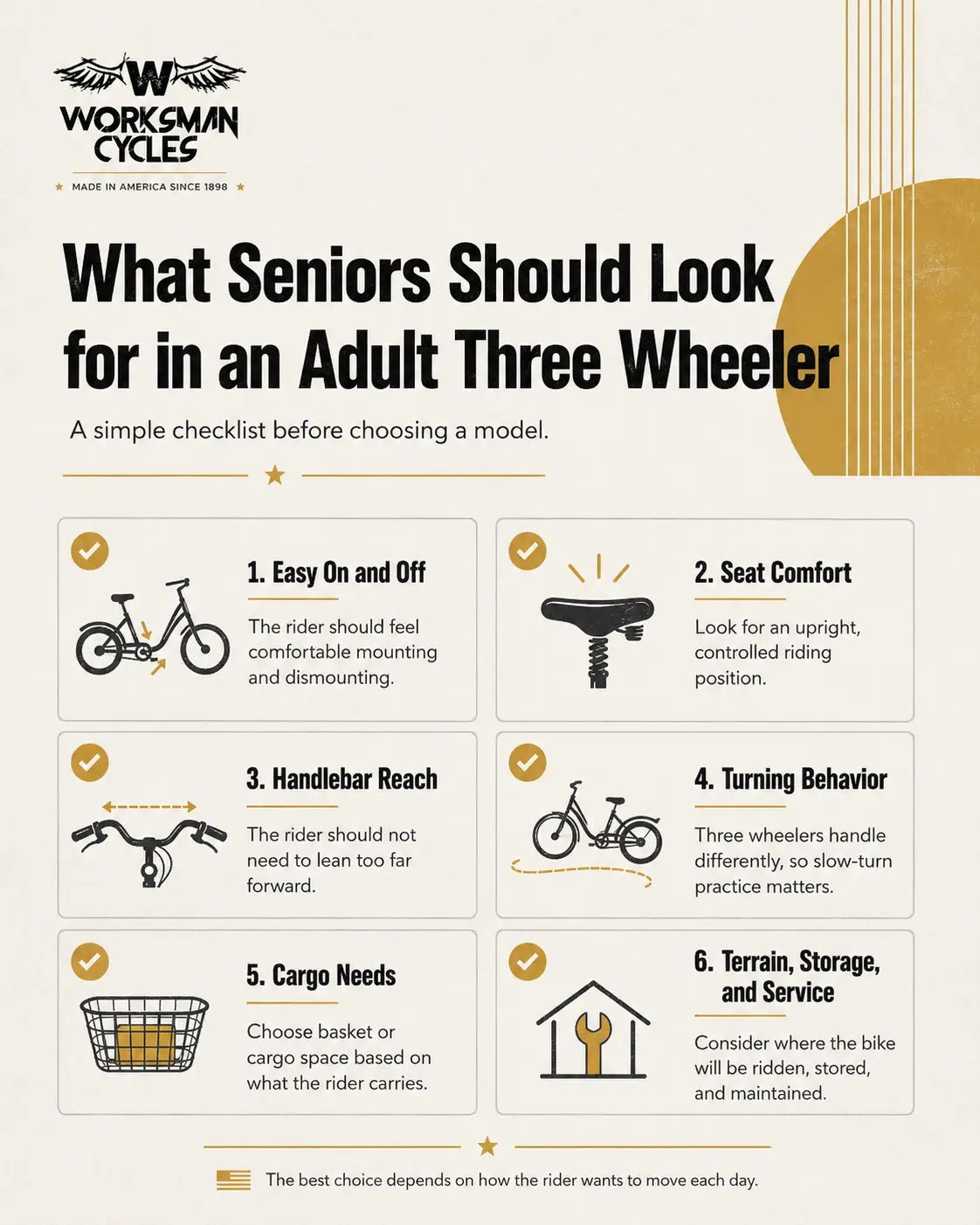
Before choosing a model, seniors and family members should look at:
- Mounting and dismounting:The rider should feel comfortable getting on and off without strain or hesitation.
- Seat comfort and position:The bike should support an upright, controlled riding posture.
- Handlebar reach:The rider should not have to lean too far forward or overextend their arms.
- Turning behavior:Three wheelers handle differently from two-wheel bikes. Riders need to practice turns at slow speeds.
- Cargo needs:A basket or cargo area should match the rider's planned load.
- Terrain:Smooth pavement, park paths, hills, and uneven surfaces all change the riding experience.
- Storage space:Adult three-wheelers take up more space than standard bicycles, so home storage needs to be realistic.
- Serviceability:The bike should be easy to maintain through available parts, clear construction, and practical design.
This is where a company like Worksman Cycles should guide buyers toward fit, use case, and long-term ownership. The goal is not to sell the same model to every senior. The goal is to help the rider choose a three wheeler that matches how they want to move.
Why Worksman Cycles Fits Senior Mobility
Worksman Cycles has a natural place in this conversation because the company's products are built around practical transportation, adult tricycles, cargo use, and long-term utility. That matters for seniors because the bike is not a disposable recreational item. It becomes part of how the rider stays active and handles local routines.
Our features fit senior mobility:
- Practical design over trend-driven features.
- Stable riding for local use.
- Cargo space for everyday errands.
- Durability for long-term ownership.
- American manufacturing credibility using high-quality domestic and imported parts.
- A clear distinction between recreational riding, utility riding, and industrial-grade build expectations.
Keep Riding, Keep Routine, Keep Independence
The biggest advantage of an adult three wheeler is that it helps seniors adapt without giving up active local mobility. A traditional bicycle may become too demanding. Walking may limit range and carrying ability. Powered devices may be more than the rider needs. An adult three-wheeler offers many seniors a practical middle ground.
The strongest reason to choose one is fit. If the rider wants stable, local, useful movement, the right adult three-wheeler can help them keep riding, keep running small errands, and participate in daily life with more confidence.
For Worksman Cycles, that is the core message. Adult three wheelers are not only about safety. They are about preserving the ordinary freedoms that matter: getting outside, carrying what you need, moving at your own pace, and staying connected to the places around you.