


Since 1898
Since 1898
*using high quality
domestic and imported parts

Should Your Business Replace A Van With A Cargo Bike?
 Local delivery gets expensive when a business uses too many vehicles for the job. A customer places an order, your team loads it, and someone drives it across town. The real cost shows up when that driver circles for parking, sits in traffic with one small order inside, gets a ticket, burns fuel, misses a delivery window, or ties up a van that could be doing heavier work.
That is why cargo bikes deserve a serious look from urban business owners and managers. A cargo bike is not a full replacement for every car, van, route, or load. It is worth considering when your business has short, local, repeat trips where a full-size vehicle creates more cost and delay than the delivery requires.
The Business Case in the Numbers
The strongest argument for cargo bikes is not image, sustainability, or trend value. It is the operating math. When stops are close together, and parking slows down vans, cargo bikes can move faster, cost less per delivery, and reduce wasted vehicle time.
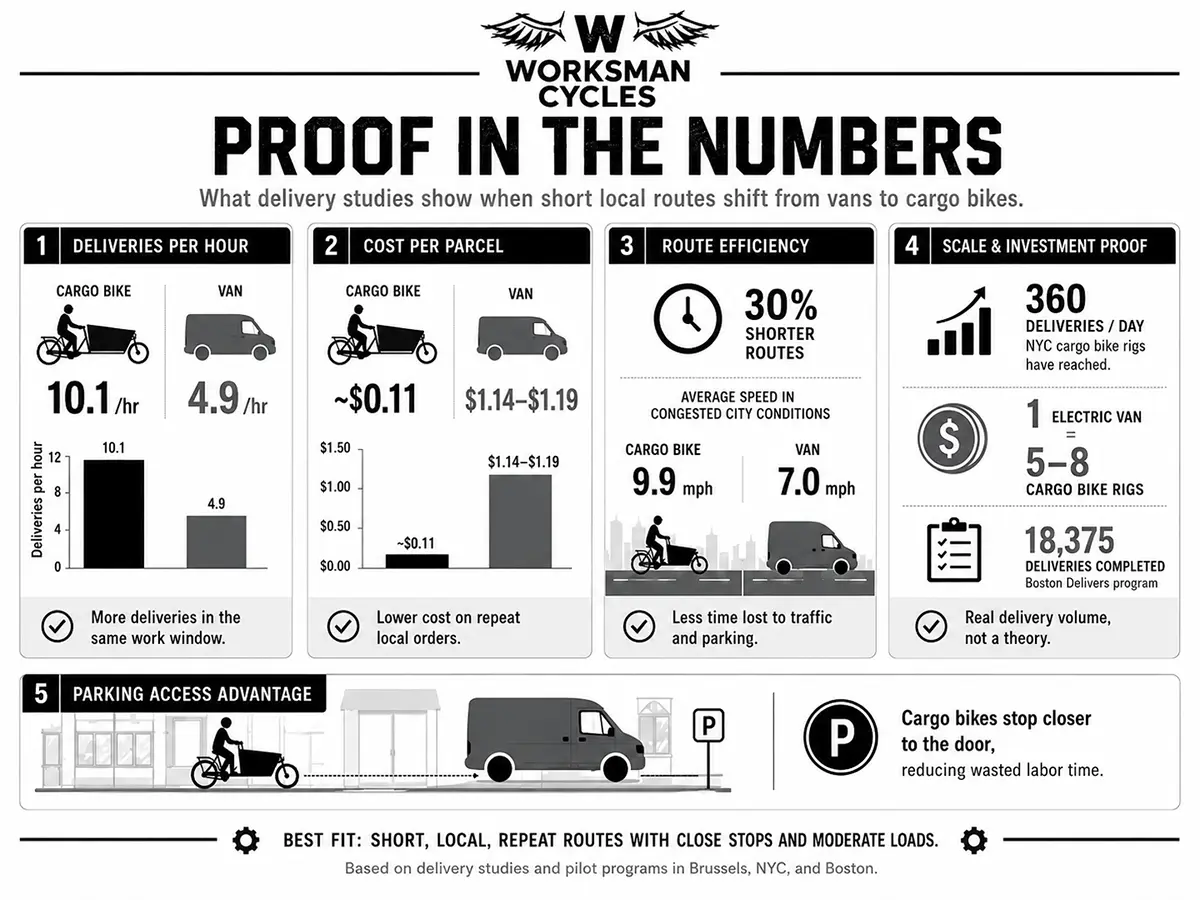
The table below focuses on the numbers that matter most to a business owner: delivery output, cost per parcel, route efficiency, parking access, vehicle investment, and proof from real city delivery programs.
What The Data Shows |
What It Means For Your Business |
Cargo bikes completed 10.1 deliveries per hour vs 4.9 by van. |
More deliveries can get done in the same work window when stops are close together. |
Cargo bike delivery cost was about $0.11 per parcel vs about $1.14–$1.19 by van. |
Small local deliveries can cost less to complete, which protects margin on repeat orders. |
Cargo bikes used 30% shorter routes. |
Riders can take more direct local paths instead of following van routes through traffic-heavy streets. |
Cargo bikes averaged 9.9 mph in congested areas vs 7.0 mph for vans. |
In city traffic, the smaller vehicle can move more consistently and reduce delivery delays. |
Cargo bikes stopped about 30 meters from delivery points. |
Less walking from the vehicle to the door means less wasted labor time at each stop. |
Cargo bike rigs reached about 360 deliveries per day in NYC. |
Cargo bikes are not limited to light errands. They can support serious delivery volume when the route fits. |
One electric van’s capital cost could place 5–8 cargo bike rigs into service. |
A business can add local delivery capacity without taking on another full van purchase. |
Boston Delivers completed 18,375 deliveries and about 6,000 cargo-bike miles. |
U.S. city pilots show cargo bikes working for real local delivery programs, not only theory. |
The clearest van-to-cargo-bike comparison comes from the Kale AI, Urbike, and Larry vs Harry delivery study in Brussels. It analyzed GPS data from electric cargo bikes across more than 7,340 deliveries and 907 routes. That study provides the delivery-per-hour, route length, speed, and cost-per-parcel values in the table. The dollar figures use a rough conversion of €1 = $1.08, turning €0.10 per cargo-bike parcel into about $0.11, and €1.05–€1.10 per van parcel into about $1.14–$1.19.
The point is not that every cargo bike route will match these numbers. The point is that the strongest results appear when the work fits the vehicle: short trips, close stops, moderate loads, and parking-heavy local routes. For a business owner, this table should raise one practical question: which trips are already costing too much because they are being handled by a van when they do not need one?
New York and Boston make the data more relevant for U.S. business owners. The Tern Business NYC case study found cargo bike rigs reaching about 360 deliveries per day and estimated that one new electric van’s capital cost could place five to eight cargo bike rigs into service. Boston Delivers completed 18,375 deliveries and about 6,000 cargo-bike miles during its pilot.
The Real Question: Which Trips No Longer Need A Van?
A cargo bike becomes worth it when a business can stop using a van for work that does not need van capacity. Many daily trips involve a few boxes, prepared food, flowers, supplies, parts, tools, documents, or local customer orders. When those trips happen within a compact service area, the van often becomes the expensive part of the delivery.
This matters because businesses often judge vehicles by their maximum capacity rather than their normal use. A van is useful when the load fills the van or the route is long. It is wasteful when the business uses it to move a small order a few miles through traffic. The cargo bike solves that mismatch by right-sizing the vehicle to the work.
A cargo bike is most likely to make business sense when the route has these conditions:
- The route is short.Most stops sit inside a compact local service area.
- The stops are close together. Delivery density lets the bike move quickly between customers.
- The load is moderate.The cargo fits safely within the bike’s weight and volume capacity.
- The route repeats.Repeat trips give the business enough data to measure savings.
- Parking slows the current vehicle.If the driver spends too much time finding a legal stop, the cargo bike has a stronger case.
- The trip does not require a full vehicle.A few boxes, bags, tools, parts, meals, flowers, or supplies may not justify a van.
The University of Washington ResearchWorks study supports this route-based view. It found e-bike delivery operations performed best in service areas with high customer density. At the highest customer demand level, e-bikes traveled 7.7 percent fewer miles to deliver a package and emitted 91 percent less tailpipe CO2 than traditional delivery vehicles.
 Parking Is Where Vans Lose Money
Parking is not a small inconvenience. It is labor time, vehicle time, delivery delay, ticket risk, and extra walking distance. If a driver spends eight minutes finding a place to stop for a small local order, the business has already lost margin by the time the handoff occurs.
The Kale AI, Urbike, and Larry vs Harry Brussels delivery study shows why cargo bikes perform better in this part of the job. Cargo bikes took 30 percent shorter routes, moved faster in congested conditions, and stopped about 30 meters from delivery points. Vans had to deal with congestion, longer routes, and more parking friction.
The New York City case study points to the same issue. It cites University of Washington research finding that commercial delivery vehicles in dense city centers spent about 28 percent of total trip time searching for parking. It also notes that vans had a median dwell time of 17.6 minutes on dense routes, while cargo bikes had median dwell times of 4.3 minutes.
Cost Is the Main Reason to Test One
A cargo bike starts to make business sense when the van costs more than the delivery is worth. A van brings fuel, insurance, maintenance, depreciation, parking tickets, registration, repairs, and downtime. Those costs may sit in different parts of the budget, but they all affect the true cost of moving one order, box, tool kit, or supply run.
The Brussels delivery study found that cargo bikes cost about $0.11 per parcel, compared with about $1.14 to $1.19 per parcel by van. For a business doing repeat local deliveries, that difference matters because the cost repeats every time the vehicle leaves the shop. If a route runs daily, the savings are not theoretical. They build across every stop, every week, and every route.
The New York City case study makes the same point from an investment perspective. A complete cargo bike rig was estimated at under $10,000, while a Class 2 to 3 electric delivery van was estimated at $45,000 to $80,000. The study concluded that the cost of one new electric van could put five to eight cargo bike rigs into service.
Where a Cargo Bike Does Not Make Sense
A cargo bike is not the right answer when the load is too heavy, too large, or too inconsistent for the bike. It is also not the best tool for long routes, highway travel, spread-out suburban deliveries, or work that requires a full vehicle of equipment. A business should not buy a cargo bike because they are gaining popularity. It should buy one because the route, load, and operating pattern fit.
The strongest cargo bike case is partial vehicle replacement. Most businesses do not need to replace every van. They need to identify the trips where the van is wasting money: short local errands, repeat deliveries, small orders, light supply runs, and close-range service routes.
A cargo bike is less likely to work well when the business depends on these conditions:
- Long-distance routes. If most deliveries stretch far outside the local service area, the van may still be the better vehicle.
- Heavy or oversized loads.If the load regularly exceeds the bike’s safe capacity, forcing the bike into the job creates risk.
- Low stop density.If stops are far apart, the bike loses the advantage it has in compact urban routes.
- Unpredictable cargo.If every trip has a different size, weight, or handling need, the bike may only fit a small portion of the work.
- No secure storage.A business needs a safe place to store the bike, cargo box, batteries, and accessories.
- No rider plan.A cargo bike still needs a trained rider, a route process, and basic operating rules.
How to Decide If Your Business Should Test One
The best first step is not replacing a vehicle. The best first step is testing one route that already feels inefficient by car or van. Pick a recurring route where your team deals with parking, traffic, short stops, small loads, or frequent local movement.
Track the current route before making any changes. Record the total miles, number of stops, average delivery time, load size, parking delay, labor time, fuel use, tickets, missed delivery windows, and vehicle availability. Then run the same route on a cargo bike and compare the results.
At Worksman Cycles, we look at cargo bikes through the same lens our business customers use. What trip does this replace? What load does it carry? How often does the route repeat? How much does the business spend sending a car or van to do work that a cargo bike could handle?
Cargo bikes are not universal replacements for cars, vans, or trucks. The data shows something more useful: they can replace specific short, local, repeat trips that would otherwise require a larger vehicle, saving money and time. If your daily work includes local movement of goods, tools, food, supplies, or small orders, a Worksman cargo bike may give your business a cleaner, lower-cost, more practical way to move.