


Since 1898
Since 1898
*using high quality
domestic and imported parts

Choosing the Right Cargo Bike for Your Campus Needs
Cargo bikes belong in the same procurement conversation as carts, tuggers, service vehicles, and other right-sized campus equipment. For facilities, maintenance, warehouse, security, and grounds teams, the decision is not about lifestyle appeal. It is about moving people, tools, parts, supplies, and materials predictably across a controlled work environment.
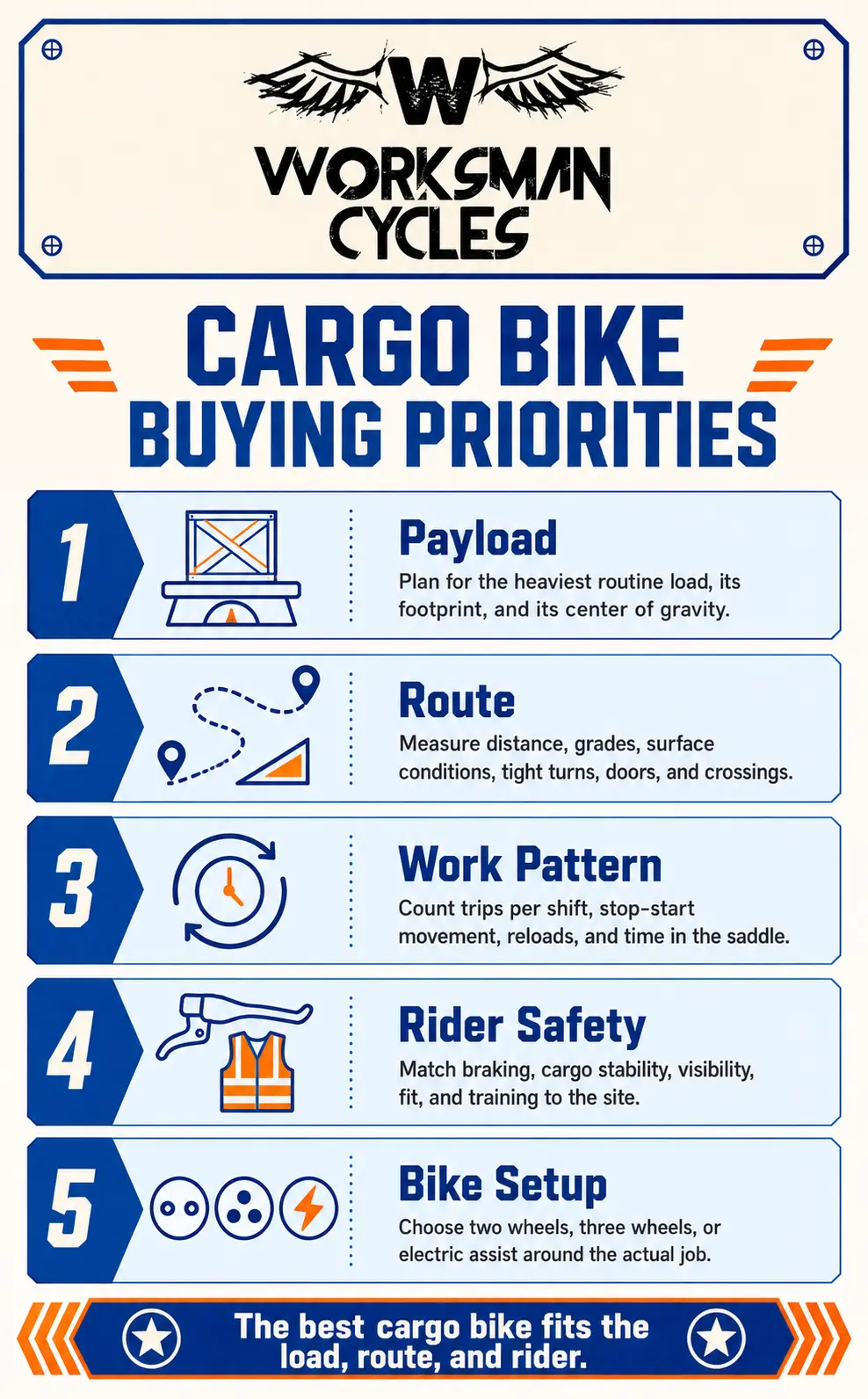
Before selecting a cargo bicycle, define the job with the same discipline used for any workplace mobility asset. Payload, route distance, surface conditions, rider posture, braking needs, visibility, and training shape whether a two-wheel cargo bike, three-wheel platform, compact electric cargo bike, longtail cargo e-bike, or cycle truck configuration fits the work. The core question is simple: how do you match the load, route, and rider safety requirements before buying?
Typical cargo includes tools, parts bins, mail, PPE, samples, supplies, light equipment, and grounds materials. Route factors include indoor and outdoor travel, grades, pavement quality, intersections, and shared pedestrian zones. Rider factors include shift length, stop frequency, physical effort, mounting height, and handling confidence.
How Much Payload Capacity Do You Actually Need?
A published capacity rating is a starting point, not the full purchasing answer. A dense 150-pound parts bin carried low may feel more controlled than a bulky, lighter carton sitting high or shifting while cornering. Document each routine load’s dimensions, center of gravity, tie-down needs, and loading frequency.
| What to assess | Why it matters |
| Heaviest routine load | Guides frame, wheel, tire, and braking requirements |
| Largest load footprint | Determines whether front, rear, or platform carrying fits |
| Load height and center of gravity | Affects balance, turning, and stopping control |
| Loading frequency | Identifies whether operators need easier access or lower rack height |
| Cargo security | Determines whether bins, baskets, flatbeds, straps, or enclosed carriers are needed |
Weight alone does not determine the right configuration. A load that must remain visible and accessible at every stop may fit on a front platform or a cycle truck. A long, narrow load may work better on a rear platform. Bulkier materials moved at low speed may call for a three-wheel utility bicycle with a larger cargo area.
Consider Front, Rear, and Three-Wheel Cargo Configurations
Front platform and cycle truck designs work well when operators need to see and reach organized containers during frequent stops. Rear-rack and longtail cargo e-bikes suit longer internal transfers, paired panniers, and narrower routes where steady travel matters.
Compact electric cargo bikes fit facilities with limited storage space and moderate loads moving across larger campuses. Three-wheel utility bikes suit larger cargo volume and low-speed movement where stable carrying matters more than tight maneuvering. Measure doorways, corridors, turns, storage areas, and loading zones before selecting a configuration.
How Far Will Riders Travel During a Typical Shift?
Distance is not just mileage on a map. A half-mile route with rough pavement, grades, gates, and repeated dismounts may be more demanding than a longer smooth loop. Review the full travel pattern before deciding whether a non-electric cargo bike, electric cargo bike, or cargo e-bike setup fits daily use. Route planning should account for starts, stops, turns, braking, reloads, and shift length. Frequent stops require riders to repeatedly get a loaded bike moving again. Long shifts increase fatigue, which affects attention, reaction time, and consistency in handling.
Match Distance, Terrain, Stops, and Shift Patterns
Short, flat routes with few stops place less physical demand on riders, making non-electric utility bikes practical. Repeated starts, stops, grades, ramps, and long loops add effort, especially when riders carry loads or work multi-hour shifts. Electric assist helps maintain more consistent effort across these conditions.
Rough pavement and expansion joints call for durable wheels, suitable tires, stable cargo mounting, and controlled braking. Headwinds and exposed routes can make travel times less predictable. Review charging access, battery range, speed policies, and maintenance responsibility before choosing an electric model.
Decide When Electric Assist Is Useful for Campus Routes
Electric assist is most useful when the same rider covers distance repeatedly while carrying meaningful weight. It does not replace sound route planning, braking capacity, or load control. It helps manage hills, wind, longer loops, frequent stop-start travel, and end-of-shift fatigue. Choose non-electric cargo bikes for short, predictable trips with lighter loads. Consider a compact electric cargo bike where storage is limited, but routes are spread out. Use electric assist when riders face grades, long loops, or frequent stop-start movement.
What Rider Safety Factors Should Procurement Require?
Safety specifications should start with controllability, not accessory preferences. A cargo bike operating around loading areas, production buildings, parking lanes, and pedestrian crossings must stay predictable while loaded, turning, stopping, and moving at low speed.
The safer option is the one that matches the route, cargo, turning space, surface quality, and rider skill. Two-wheel utility bicycles often suit narrower paths and riders comfortable with bicycle handling. Three-wheel configurations support slower, more stable movement with bulkier cargo, though they need more room to turn.
Key Safety Terms
- Load stabilitymeans cargo stays secure during starts, turns, braking, and travel over uneven surfaces. Secure cargo placement prevents shifting that could affect balance or steering.
- Braking controlmeans the bicycle stops safely with the expected load and route conditions. Brakes, tire condition, cargo placement, and rider position all affect stopping performance.
- Ergonomic fitmeans riders can mount, dismount, reach controls, and handle loads without unnecessary strain. A proper fit matters more when the same equipment is used repeatedly through a full shift.
- Predictable handlingmeans the bike responds consistently at low speeds, through turns, and around obstacles. This is especially important around pedestrians, loading areas, and uneven ground.
- Operating procedurescover right-of-way, speed, crossings, parking, loading, and rider training. Site rules should match the areas where the cargo bike will operate.
Require a written maximum payload and loading method. Specify parking brakes or secure stopping features where needed. Confirm serviceability for tires, brakes, chains, wheels, and assist components. Align rider rules with site traffic-control practices and provide orientation before daily use.
Turn Your Requirements Into a Cargo Bike Specification
Start with the work pattern, not the model name. Define the task in measurable terms so the cargo bicycle fits the daily job rather than a broad product category. Record the heaviest realistic load, its dimensions, where operators must access it, and how often it moves during a shift.
Document route length, grades, surface conditions, tight turns, storage space, and charging access. Include rider group, shift duration, expected trip frequency, and any areas where site policy or layout requires lower operating speeds. Note required features such as lighting, reflectivity, a horn, basket, cabinet, rack, or enclosed carrier.
A compact electric cargo bike may be suitable for frequent medium-distance trips. A longtail cargo e-bike may suit balanced rear loads and longer internal routes. A three-wheel utility bike may better serve low-speed movement of heavier materials, while a two-wheel cargo bike may suit experienced riders moving through narrower areas.
These details make comparisons clearer and keep carrying capacity, maneuvering space, rider confidence, and braking control connected throughout the selection process.
Getting the Right Ride for Your Campus or School
Choosing the right cargo bike for a plant, warehouse, school, or private campus begins with understanding the work requirements. Consider what must move, how far riders travel, the surfaces crossed, and the safety measures required for daily operation.
Treat payload, route length, terrain, stopping frequency, visibility, braking, ergonomics, and rider confidence as connected buying criteria. Contact Worksman Cycles with your load ranges, route patterns, ground conditions, and operator needs. Those details support a cargo bike recommendation tailored to your facility.