


Since 1898
Since 1898
*using high quality
domestic and imported parts

When Are Cargo Bikes a Better Choice Than Vans for Urban Delivery?
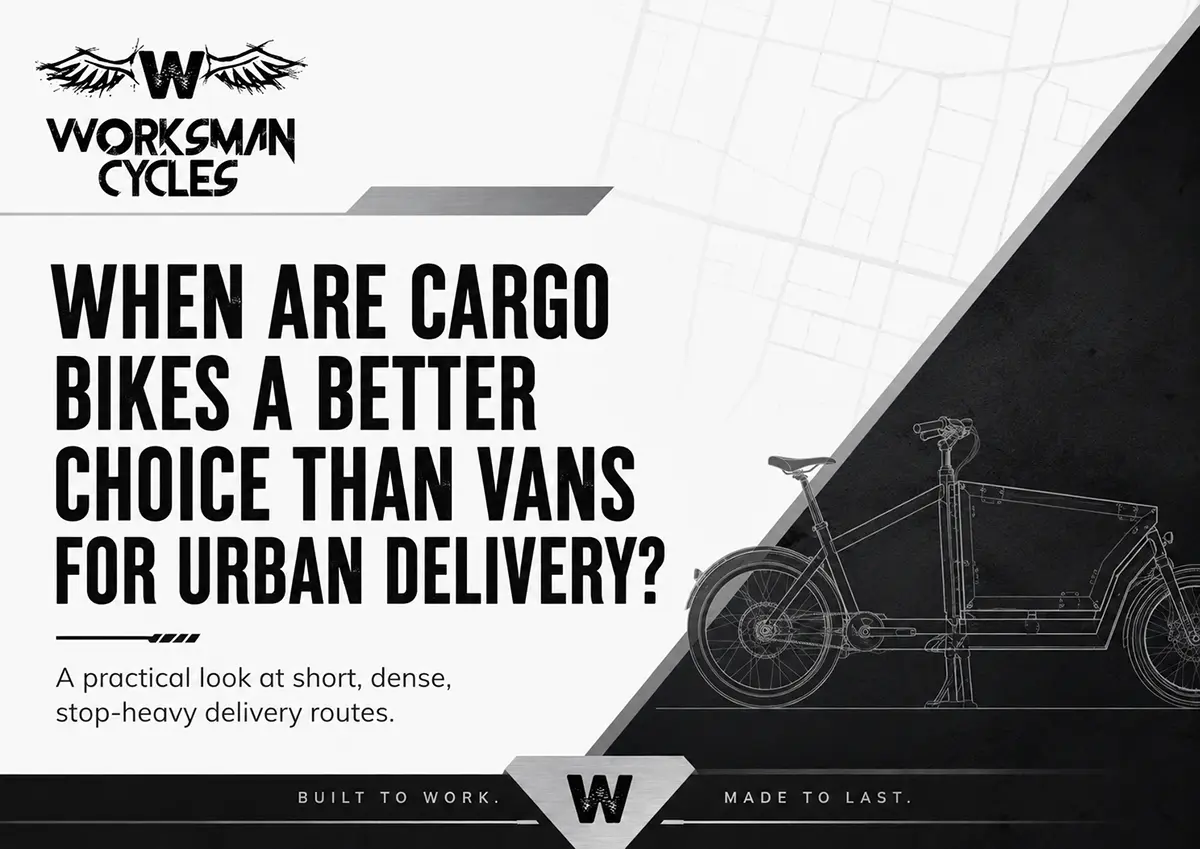
Cargo bikes are not the right vehicle for every delivery route. Vans still make sense for heavy loads, longer trips, wide service areas, and bulk deliveries. The problem starts when businesses use vans for routes where the vehicle is larger than the job requires.
In dense urban delivery, the biggest issue is often not distance. It is access. Drivers lose time in traffic, circle for parking, double-park near customers, and make repeated short trips with partial loads. On those routes, a cargo bike can be the better operating tool.
The U.S. Environmental Protection Agency reports that transportation accounted for 28% of total U.S. greenhouse gas emissions in 2022. That does not mean every business should replace its fleet overnight. It does mean local delivery decisions matter, especially when companies repeat the same inefficient short trips every day.
The right question is not whether cargo bikes should replace vans. The better question is which routes are too short, too dense, too stop-heavy, or too curb-constrained for a full-size vehicle.
Why Dense Urban Delivery Needs a Different Vehicle Strategy
*PAGE 1 IMAGE GOES HERE
Cargo bikes make the most sense when the delivery route itself creates the waste. A van stuck in traffic, circling for parking, double-parked near a customer, or making short trips with a small load is not being used to its full potential. It is carrying excess vehicle size into a route where access matters more than horsepower.
In its New York City urban freight case study, the Federal Highway Administration explains that limited loading and unloading zones forced trucks and larger vehicles to double-park in Midtown Manhattan, reducing street capacity by one lane. That is the real urban delivery problem. The vehicle is not only moving goods. It is also competing for curb space.
Cargo bikes help because they change the access equation. They reduce the amount of street and curb space needed for certain local delivery trips. They also give businesses a way to serve compact zones without sending a full-size vehicle into every stop.
Route Conditions That Make Cargo Bikes Practical
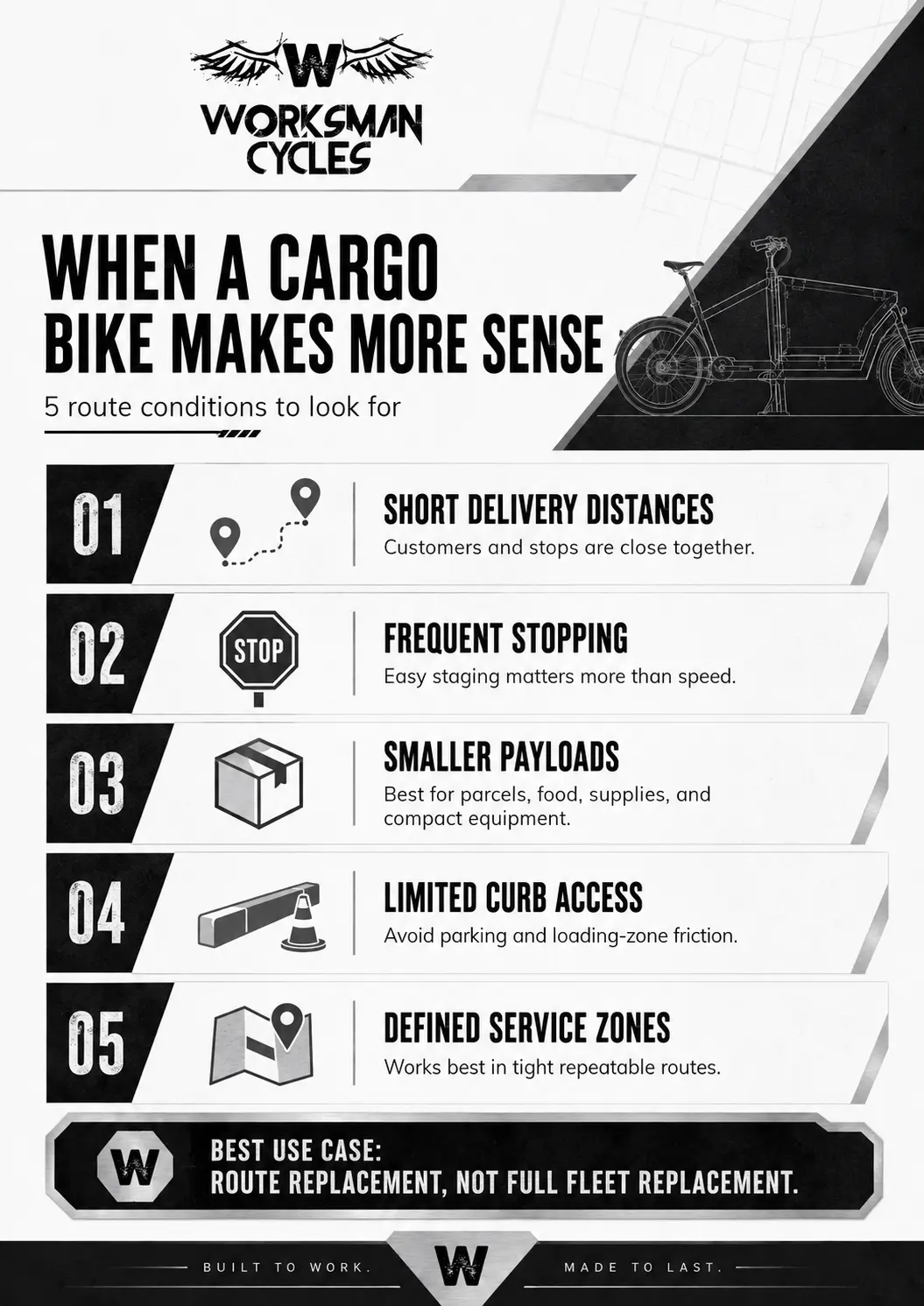
For a business, this matters most in routes with these conditions:
- Short delivery distances:Cargo bikes fit trips where customers, service points, or vending stops sit close together. The tighter the route, the more the business benefits from a smaller vehicle.
- Frequent stopping:A route with many stops magnifies the cost of parking, loading, unloading, and walking from the vehicle. A cargo bike reduces some of that friction because it is easier to stage near the point of delivery.
- Smaller payloads:Cargo bikes work best when the load does not require a van. Parcels, food orders, maintenance supplies, vending inventory, printed materials, and compact equipment are better fits than large freight.
- Limited curb access:In areas where vans lose time looking for loading space, a cargo bike gives the operator more placement flexibility.
- Defined service zones:Cargo bikes perform best when the business knows the route boundaries. A tight delivery zone is easier to plan, staff, and repeat.
These are not minor details. They decide whether a cargo bike is a smart operating tool or a poor substitute for a larger vehicle.
The Best Use Case Is Route Replacement, Not Fleet Replacement
*PAGE 2 IMAGE GOES HERE
Many treat cargo bikes as if they are trying to replace delivery vans completely. That framing is too broad and not useful for business owners. A better approach is route replacement. A business should not ask whether cargo bikes replace its fleet. It should identify which routes are over-vehicled. An over-vehicled route uses more vehicle than the job requires. The load is light, the stops are close, the route is local, and the van's size creates more problems than it solves.
In a 2025 peer-reviewed study published through ScienceDirect on cargo bike delivery in Zagreb, researchers compared a van-only delivery model with a two-stage model using cargo bikes from a city micro-hub. The cargo bike model reduced CO2 emissions by around 40% and reduced operational time by 23.5 minutes per delivery cycle.
That study matters because it does not present cargo bikes as a magic fix. It shows that cargo bikes perform best when the delivery system supports them. The micro-hub matters. The route design matters. The density of stops matters. The vehicle works because the delivery model fits the vehicle.
For Worksman Cycles customers, this is the practical takeaway. Cargo bikes, industrial bicycles, and vending solutions should be selected based on the work pattern, not on a generic sustainability claim. A business using a cargo bike for short, repeated urban movement is making a logistics decision first and an environmental decision second.
Cargo Bikes Solve a Space Problem, Not Only an Emissions Problem
Emissions are important, but they are not the only reason cargo bikes matter. In cities, space is often the immediate constraint. Streets have finite room. Curbs have finite room. Sidewalk-adjacent loading space has finite room.
The EU Urban Mobility Observatory describes cargo bikes as a way to reduce the number of delivery vans blocking roads, cycle paths, and pavements. It also notes that cargo bikes use less space and fewer resources, and produce fewer or no emissions at the point of use.
That point helps separate serious cargo bike planning from generic green delivery language. Cargo bikes are not only cleaner. They are smaller. In dense delivery work, smaller is an operational advantage.
Operational Friction Cargo Bikes Can Reduce
- Time lost to curb access problems
- Pressure on loading zones
- Unnecessary short van trips
- Inefficient vehicle use
- Local delivery friction in compact districts
This is why cargo bikes make sense for courier services, food and grocery delivery, campus operations, municipal maintenance, event work, mobile vending, and dense-neighborhood routes. These jobs often need access more than cargo volume.
Cargo Bikes Need the Right Operating Model
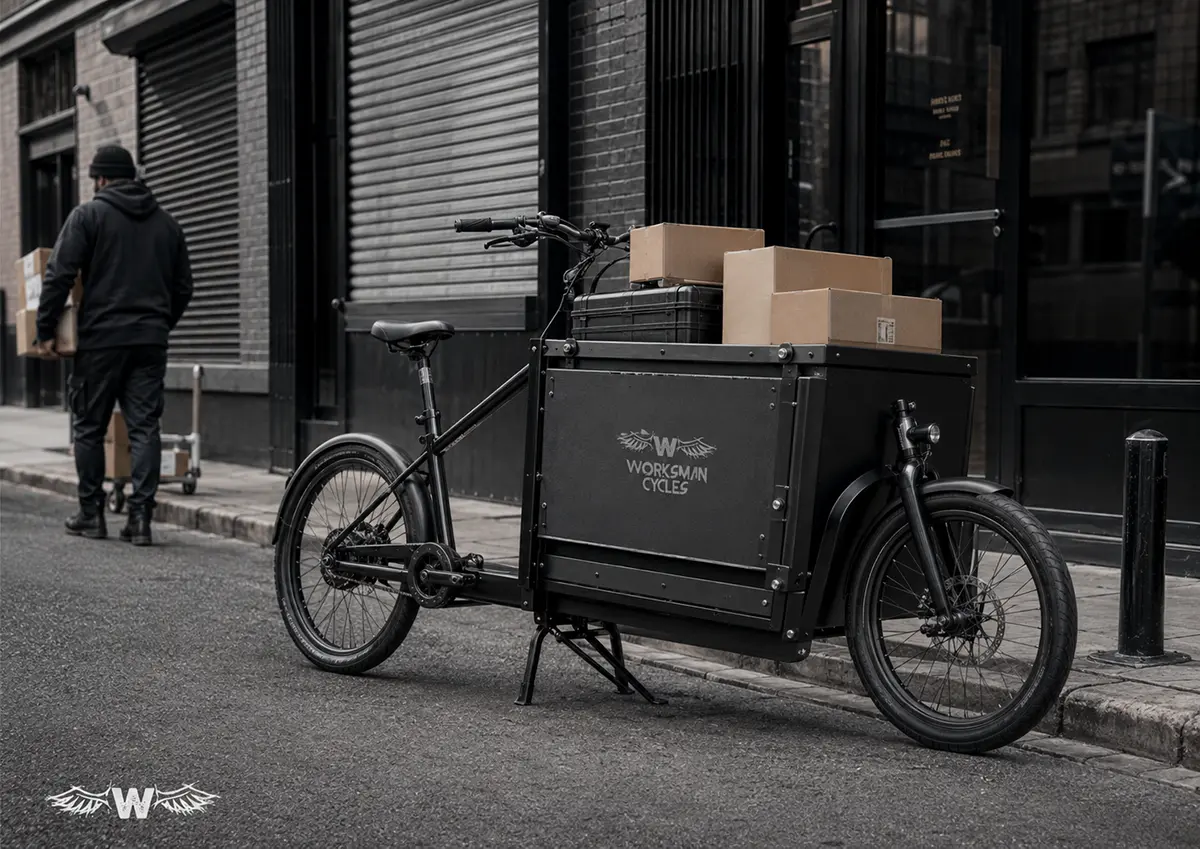
A cargo bike is only as useful as the system around it. A business still needs route planning, secure storage, rider training, maintenance, loading procedures, and clear service boundaries. Without those pieces, the bike becomes another under planned asset.
A 2022 peer-reviewed review in Transportation Research Interdisciplinary Perspectives found that electric cargo bike adoption has grown through technological development, infrastructure improvements, and government support. The same review emphasized city readiness, including infrastructure and operating conditions.
That means a business should review the route before it reviews the bike. The right question is not only how much the bike carries. The right question is how the bike fits the route, staff, storage, customer expectations, and delivery timing.
Commercial Buying Factors
For commercial use, buyers should look closely at:
- Payload needs
- Braking demands
- Frame strength
- Rider comfort
- Daily route distance
- Storage requirements
- Weather exposure
- Maintenance access
- Branding or vending setup
- Loading and unloading workflow
A consumer-style bike is not the same thing as a work vehicle. Businesses need equipment built for repeated use, predictable handling, and practical service needs.
Where Cargo Bikes Fit Compared With Vans
This comparison works best when businesses judge the route, not the vehicle category. Cargo bikes and vans solve different problems. The mistake is forcing one vehicle to do work that belongs to the other.
Route or Operating Factor |
Better Fit for Cargo Bikes |
Better Fit for Vans or Trucks |
Delivery distance |
Short, dense, local routes |
Longer routes across wider service areas |
Stop pattern |
Many close stops |
Fewer stops spread farther apart |
Payload |
Small to medium loads |
Heavy, bulky, or high-volume loads |
Curb conditions |
Limited parking or loading access |
Reliable loading zones or dock access |
Route environment |
Dense districts, campuses, downtown zones |
Suburban, regional, or mixed-route delivery |
Business use |
Courier, vending, food, parcels, maintenance, local service |
Bulk delivery, wholesale drops, large equipment, long-haul support |
The table shows the core point. Cargo bikes are strongest where vans lose efficiency because of route conditions. Vans still matter. Trucks still matter. The opportunity is to stop using them for routes where their size creates unnecessary cost and friction.
How Businesses Should Evaluate Cargo Bike Adoption
A business should start with route data, not product preference. Look at delivery density, number of stops, average payload, distance between stops, parking delay, driver time, fuel use, and how often the vehicle returns partly empty.
The best initial test is usually a defined route. Choose one dense service area, one repeated delivery pattern, or one vending route where the business already sees friction. Then compare delivery time, parking issues, labor requirements, customer service, and operating costs with the current vehicle setup.
This is also where American-built, work-focused equipment has a stronger role than generic bike options. Worksman Cycles builds practical vehicles for real business use, including cargo bikes, industrial bicycles, and vending solutions. That matters when the bike is not for recreation. It is part of the workday.
Companies that want to reduce waste in urban delivery should not begin with a broad sustainability promise. They should begin with the route. If the route is short, dense, stop-heavy, and limited by curb access, a cargo bike is not a novelty. It is the right-sized vehicle for the job.