


Since 1898
Since 1898
*using high quality
domestic and imported parts

Why Does My Adult Tricycle Feel Unstable When Turning? (And How to Fix It)
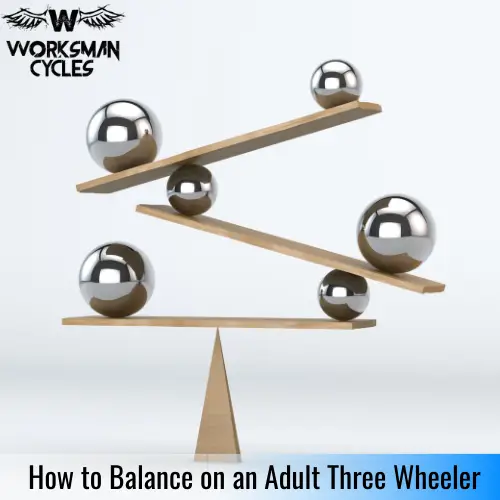
An adult tricycle feels wobbly during turns because it cannot lean like a standard two-wheel bicycle. This causes centrifugal force to pull your body weight toward the outside wheel. To prevent an adult tricycle from tipping over, you must:
- Use the "Slow In, Fast Out" method:Brake before entering a turn, maintain a steady speed through the apex, and only accelerate when riding straight.
- Shift your body weight:Apply pressure to your "outside" hip to keep the outer rear tire firmly planted on the ground.
- Ride an industrial-grade frame:Tricycles engineered with wider rear tracks (31.5" +) and heavy-gauge steel frames drastically lower your center of gravity compared to lightweight, narrow imports.
The Physics of Tipping: Why Trikes Handle Differently Than Bikes
The architectural design of an adult three wheeler requires a fundamentally different operating approach than that of a standard bicycle. A bicycle utilizes a single-track design, allowing the rider to lean the frame into a turn to counteract centrifugal force. A tricycle operates on a multi-track configuration that remains flat and perpendicular to the road, creating a "stability triangle" between the three tires.
Because the frame does not lean, all lateral forces are absorbed by the chassis and the rider. During a turn, centrifugal force pushes against your center of gravity. If that force pushes your mass outside the lateral boundary of the stability triangle, the inside rear wheel will lift.
This rigid multi-track design also causes "pedal steer" and direct steering. Small inputs at the handlebars result in immediate, non-leaning changes in direction. If you feel unstable on a new tricycle, it is rarely a mechanical failure; it is simply your vestibular system needing 5 to 10 minutes to recalibrate to a vehicle that follows the road's slope rather than leaning into it.
How to Master the Turn on an Adult Three Wheeler
Because the machine cannot lean to manage these physical forces, the rider must actively manage them. Attempting to steer a tricycle with the same aggressive, high-speed inputs used on a bicycle is the primary cause of tipping.
- The "Slow In, Fast Out" Protocol:You must ensure that centrifugal force never breaches your tipping threshold. Brake well before you begin turning the handlebars. Maintain a slow, highly controlled speed through the apex of the curve. Do not apply heavy pedaling or electric throttle until the front wheel is pointed straight ahead.
- The Weight Shift Technique:While you cannot lean the bicycle frame, you can shift your upper torso into the curve. More importantly, maintain heavy, deliberate pressure on your "outside butt cheek." This forces your body weight directly down over the outside rear wheel—the tire doing the hardest work to resist the turn—keeping it firmly locked to the pavement.
The Hardware: Why "Super Heavy Duty" Engineering Stops Rollovers
Rider technique is critical, but a vehicle's inherent stability is dictated by its physical geometry. An adult tricycle's resistance to tipping relies heavily on two structural variables: track width and center of gravity.
- Track Width (The Base):The distance between the rear wheels dictates how far your weight can shift before a rollover occurs. Worksman industrial tricycles, such as the Adaptable series, utilize rear axles ranging from 31.5 to 34 inches in length. This wide stance extends the tipping line far beyond what compact, narrow-axle consumer trikes can achieve.
- Center of Gravity (The Ballast):High-tensile, heavy-gauge steel (11G and 14G) is used not only for durability but also as a stabilizing ballast. A heavy steel frame creates a high "sprung mass" low to the ground. This groundedness naturally anchors the vehicle, whereas lightweight aluminum frames are easily lifted by centrifugal force or the sudden high torque of a 500-watt electric motor.
Industrial Trikes vs. Consumer Imports: The "Toy vs. Tool" Difference
A primary reason riders feel unsafe is the use of budget, recreational tricycles for heavy-duty tasks. A tricycle built to survive 24/7 operations in a manufacturing plant requires an entirely different stress-distribution profile to prevent the wheels and axles from flexing under lateral pressure.
Specification |
Worksman Industrial Standard |
Consumer/Budget Import Standard |
Rear Axle |
7/8" Machined Solid Steel |
5/8" or 3/4" Standard |
Spokes |
11-Gauge (.120") Heavy Duty |
14-Gauge (.080") Standard |
Rims |
WTC Clincher (50% thicker steel) |
Aluminum or Thin Steel |
Braking |
Automotive-Style Drum |
Caliper or V-Brakes |
Drive System |
Woodruff Key Drive |
Friction or Pin-Based Drive |
True Payload |
450–550 lbs. (Rider + Cargo) |
300 lbs. (Often includes bike weight) |
This component strength directly translates to rider stability. For example, 11-gauge spokes are nearly 50% thicker than standard bicycle spokes. Because tricycle wheels cannot lean to shed cornering forces, thin spokes will flex (or "taco") under the strain. A flexing wheel instantly shifts your center of gravity, causing the wobbly, unpredictable handling common in cheap imports.
Specialized Stability: Semi-Recumbent and Adaptive Engineering
If an upright traditional tricycle still presents balance challenges, stability can be engineered by altering the rider's physical seating position.
- Semi-Recumbent Dynamics (The PAV3):By moving the rider closer to the ground and pushing the captain's seat further back over the rear axle, the Personal Activity Vehicle (PAV3) achieves massive resistance to tipping. Extending the wheelbase reduces steering sensitivity, eliminating the "twitchy" wobble found in shorter trikes.
- Companion Riding (The Team Dual):Side-by-side tricycles require a split rear axle and an exceptionally wide footprint. This configuration creates a massive stability triangle that virtually eliminates the risk of a rollover, making it highly effective for riders who prioritize absolute balance.
The 3 Maintenance Checks That Prevent Trike Instability
Because three-wheelers do not self-center, poor maintenance directly translates to a wobbly ride. If a high-quality tricycle feels unstable, check these three mechanical points before assuming rider error.
- Rear Axle Alignment:The rear axle must remain perfectly perpendicular to the frame. A slight deviation will cause the trike to "drift" to one side, forcing the rider to make dangerous, jerky steering corrections.
- Spoke Tension:Loose spokes allow the wheel rim to bend under lateral turning pressure. This makes the ride feel "mushy" and unpredictably shifts the bike's center of gravity.
- Tire Pressure:A tire low on air creates an imbalance that perfectly mimics the feeling of a warped frame. Maintain a strict 40 PSI across all three tires to ensure predictable handling.
Engineering Confidence on Every Turn
The question of stability in adult three wheelers ultimately comes down to engineering intent. For over 125 years, Worksman Cycles has built machines not for casual weekend rides, but to survive the brutal, 24/7 realities of factory floors, warehouses, and industrial campuses. Absolute stability isn't a happy accident; it is the calculated result of wider track widths, heavy-gauge steel ballast, and precision center-of-gravity math.
If you are struggling with a wobbly, unstable ride on a budget import, the solution lies in matching the right technique with the right tool. By adopting the "Slow In, Fast Out" cornering method and upgrading to a machine built with genuine industrial-grade components, you can replace the fear of tipping with the absolute confidence of a heavy-duty mobility platform.