


Since 1898
Since 1898
*using high quality
domestic and imported parts

The Reality of the Cargo Bike Ride: Tuning the Machine to You
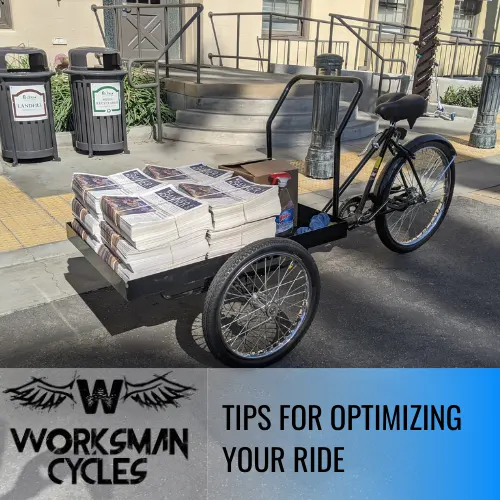 In the industrial world, we often accept that "work" means "discomfort." We assume that because a machine is built like a tank, it has to ride like one. But at Worksman, we know that pain is actually a warning light. If you are hauling heavy loads across a warehouse floor and your body is hurting, that isn't a badge of honor—it is a mechanical failure. You are the engine of this vehicle. If the engine is battling the chassis, you lose power, you lose speed, and eventually, you break down.
Comfort is not luxury; it is efficiency. By taking the time to calibrate the bike to your specific anatomy, you stop fighting the machine and start using its leverage to do the work for you.
1. The Power Plant: Why Your Knees Are Burning
The most common source of fatigue isn't the weight of the cargo; it's the geometry of your legs. When a saddle is too low—which is the number one mistake riders make—it forces your knees to flare outward and keeps your legs bunched up throughout the entire pedal stroke. This is the equivalent of walking around the facility in a deep squat; it relies entirely on soft tissue and muscle to generate force, which is why your thighs burn and your knees ache.
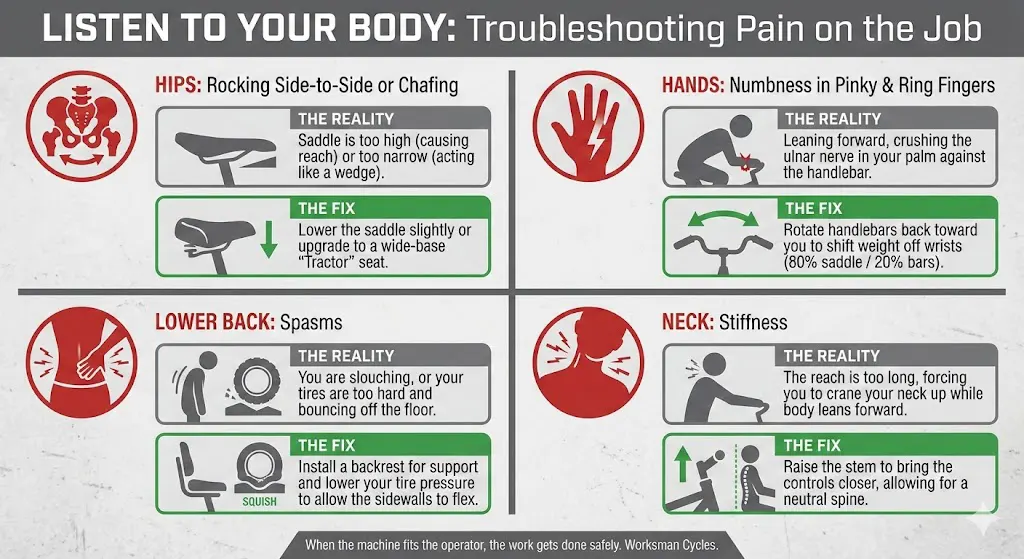
To fix this, you need to recruit your skeleton. When you raise the saddle, you allow your leg to extend almost fully—aiming for a slight 150-degree bend at the bottom of the stroke. This extension allows your bones to support the load rather than just your muscles. Additionally, because these bikes are upright, nearly 100% of your body weight rests on the saddle. If that saddle is too narrow, it acts like a wedge driving into your pelvis. You need a wide-base platform that supports your "sit bones" entirely, ensuring that your circulation isn't cut off during a long shift.
2. The Command Center: The Cause of Hand Numbness
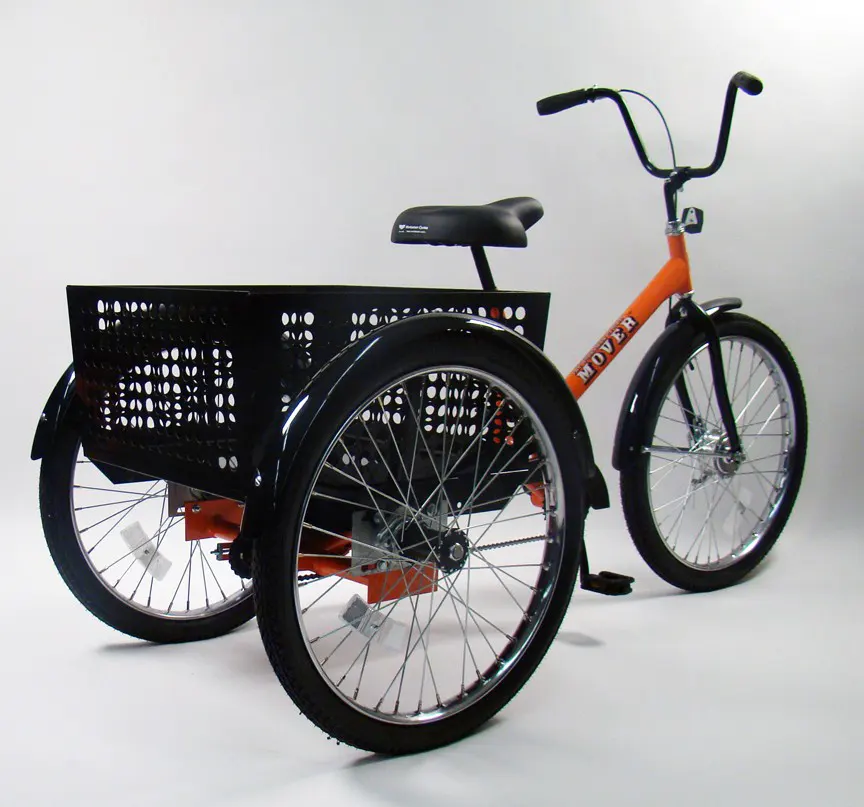
If you have ever finished a ride and felt a "pins and needles" sensation in your ring and pinky fingers, you are experiencing a mechanical error called "cyclist's palsy." This happens when you compress the ulnar nerve in your palm against the steel handlebar. Usually, this is a chain reaction caused by your seat position: if the seat is wrong, you lean forward to compensate, dumping your upper body weight onto your wrists.
The goal is to redistribute your weight so that 80% is carried by the saddle and only 20% by the handlebars. Use your hands strictly for steering, not to hold your torso upright. By rotating the handlebars back toward you, you bring the controls closer to your body, allowing you to sit upright with your spine stacked and your grip relaxed. Furthermore, if you find yourself "white-knuckling" the bars to hold on, you are actually amplifying the vibration from the road. Swapping to ergonomic "wing-style" grips creates a flat platform for your palm, spreading the pressure out and saving your nerves.
3. Chassis Dynamics: Saving Your Spine
A three-wheeled cargo bike has a unique physical trait: it does not lean into turns. The rear axle stays parallel to the ground, which means that when you hit a bump, the shock travels vertically straight up the frame and into your lumbar spine. If your tires are inflated to the maximum PSI listed on the sidewall, they become rock-hard, transmitting every crack in the concrete directly to your back.
You can create a suspension system simply by managing your air pressure. Unless you are hauling a load over 500 lbs, you should lower your tire pressure slightly. This allows the tire casing to deform and wrap over floor imperfections, absorbing the shock before it reaches the frame. For riders with existing back issues, adding a seat with a backrest changes the physics of how you generate power. Instead of pulling on the handlebars to get the pedals moving (which strains the lower back), a backrest allows you to push against the seat support, isolating your legs and keeping your spine in a neutral, protected column.
4. The Operator’s Mindset: Letting Go of Tension
Finally, we have to address the "ghost tension" many riders carry. Because most of us learned on two-wheeled bicycles, we have a subconscious habit of tensing our core and shoulders to balance the bike, especially when we slow down. But a trike operates on static stability—it cannot tip over at a stop.
When you hold that tension in your shoulders, you are burning energy that you need for your job. You have to consciously train yourself to trust the machine. When you come to a stop or are idling, physically drop your shoulders, sit back, and shake out your hands. By relaxing your upper body and letting the steel chassis do the work of staying upright, you conserve your energy for the actual work at hand.
Why Five Minutes Matters for You and Your Cargo Bike
It is easy to skip these adjustments when you are in a rush to start a shift. But an improperly calibrated machine eventually leads to operator error. In an industrial setting, a rider who is battling knee pain or hand numbness is distracted, fatigued, and slower.
Worksman Cycles builds these bikes to last for decades, but the steel frame is only one half of the equation. You—the operator—are the other half. By taking just five minutes to calibrate your saddle height, handlebar reach, and tire pressure, you aren't just making the ride "nice"; you are improving your actual performance.
Treat this fit process as part of your standard maintenance protocol, just like checking the brakes. When the machine fits the operator, the work gets done safely.